Home » blog » Page 13

Category: blog

Take Care of Your Whole Self


It’s American Heart Month! Many of us are still working from home at least part time, which creates changes to our daily routine. We aren’t moving as much as we do when at the office (with virtual meetings and less frequent breaks) and snacking more frequently. This month, let’s focus on how to support our WHOLE selves while working from home.

1. Stay active.
  • Go for a walk 2x/day
  • Walk your stairs a few times/day
  • Take dance breaks
  • Shovel snow.
  • Go snowshoeing.
2. Eat well.
  • Fruits/veggies/whole-grains
  • Healthy proteins
  • Lean poultry in moderation
  • Reduced-fat dairy
  • Unsalted seeds and nuts
  • Keep hydrated
3. Educate yourself about your heart health.
4. Check on your heart.

Let’s take a closer look at increasing your exercise this winter. If going outside, you also will want to dress in layers to keep warm and dry with a moisture wicking base layer, then fleece, and waterproof on the outside.

Getting outside to move in the winter has its advantages:
  • Cooler weather makes you feel invigorated.
  • Move longer and burn more calories.
  • Enjoy the sunlight for mood and vitamin D boosts.
  • Exercise increases your immunity.
You might need to get creative moving in the winter months. Besides traditional indoor workouts, you could try dancing, vacuuming, movement video gaming, gym apps, or YouTube classes. The goal is about 20 minutes/day (or 150 minutes/week) of exercise to improve your health. Set small goals and get moving. Be sure to check in on colleagues and friends too!
HR Synergy is happy to help you. Click here to contact us.

Happy New Year! 2022

Happy new year fireworks

Don’t forget to use our year-end-checklist  to complete your 2021 wrap-up. Also, be sure to review your policies and update, if necessary. The 2022 W-4 is available for download on the IRS website at https://www.irs.gov/forms-pubs/about-form-w-4. Everyone should begin using this new version of the form on January 1st.


Now is a great time to reevaluate and/or reaffirm COVID policies with your team to help limit contradictions between personal understanding and the various agency guidelines.
The CDC’s latest coronavirus isolation guidance update states that regardless of vaccination status:
    • Individuals should isolate for 5 days if infected with COVID and asymptomatic (or your symptoms are improving).
    • Continue wearing a mask for an additional 5 days.
    • (Additionally, stay home until your fever resolves without the aid of fever-reducing medications.)
If you are exposed to COVID, unvaccinated or are +6 months from your 2nd Pfizer/Moderna dose (or +2 months from your J&J vaccine), and not yet boosted:
    • Quarantine for 5 days with strict mask usage for an additional 5 days.
    • (If a 5-day quarantine is not feasible, you should wear a mask for 10 days.)
If you are exposed to COVID, boosted/vaccinated less than 6 months for your 2nd Pfizer/Moderna dose (or less than 2 months for your J&J vaccine):
    • No quarantine is needed.
    • Wear a mask for 10 days.
If an individual has an antigen test and wants to test, test at the end of the 5-day isolation period.
    • If the test is positive, continue to isolate until day 10.
    • If the test is negative, you can end isolation. Continue to wear a mask until day 10.
Keep in mind that the guidelines are fluid, changing frequently. It is your responsibility to stay on top of the CDC guidelines, found here. NH guidelines can be found here. Also, it is the employer’s discretion to go above and beyond the CDC and State guidance.

The Supreme Court reapplied the temporary injunction, blocking OSHA from enforcing the ETS for now. Litigation continues in lower courts over whether the emergency rule is valid.
In the meantime, consider the following:
1) Highest Priority: Complete Your Administrative Obligations
You are expected to develop compliance approaches during this time.
  • Create vaccination roster for employees.
(The EEOC has confirmed that you can lawfully ask employees their vaccination status without violating federal anti-discrimination laws (provided the question is limited to a yes-or-no response) and HIPAA does not prevent employers and businesses from asking their employees and visitors whether they have been vaccinated against COVID-19 and for proof of such vaccination.)
  • Develop vaccine and/or testing Policies
At a minimum, the policy should include requirements for:
      • employees to report positive COVID-19 tests;
      • positive COVID-19 employees to be removed from the workplace;
      • paid leave for employees to get vaccinated; and
      • ensuring unvaccinated and not fully vaccinated employees wear face coverings when indoors or when occupying a vehicle with another person.
2) Develop Educational programs for training and decimating policies.
  •  Decide if You Want to Impose Your Own Vaccine Mandate. Check this list of states and coordinate with your workplace law counsel to determine if you can proceed with a mandate at your place of business.
  • Consider Creating Safety Obligations for Non-Vaccinated Employees such as:
      • masking requirements
      • social distancing rules
      • restrictions on business-related travel
      • testing
3) Health insurance surcharge
4) Keep Vaccine Incentives in Mind
All 3 federal COVID-19 vaccine mandates are the subject of ongoing litigation.
The following is an overview for each:
  • OSHA Mandate: This mandate requires employers covered by OSHA’s jurisdiction with 100 or more employees to ensure that employees are either fully vaccinated or test weekly for COVID-19 with additional policy, vaccine data collection, and masking requirements. The nationwide court-issued stay (pause) was lifted by a federal appeals court, giving OSHA authority (for now) to enforce. OSHA will not issue citations (if employers are exercising good faith efforts to comply)  for non-compliance with any ETS requirements before January 10 and before February 9 for failing to enforce the standard’s testing requirements.
  • CMS Medicare and Medicaid Mandate: The CMS mandate applies to certain healthcare organizations that receive Medicare and/or Medicaid funding, regardless of the number of employees. This mandate requires covered employers to ensure all staff (except those granted medical and religious exemptions) are vaccinated without a test out option. This mandate is currently stayed (paused) for the 25 states, including NH, that are plaintiffs in lawsuits to block this mandate.
  • Federal Contractor Mandate: This mandate requires certain federal contractors and subcontractors to ensure that all employees (except those granted medical or religious exemptions) are vaccinated with a test out option. This mandate is currently stayed (paused) on a nationwide basis pursuant to a federal court order.
Short-Term Planning for Compliance
January 10 is the new deadline for:
    • Learning the vaccination status of every employee;
    • Obtaining proof of vaccination status;
    • Ensuring employees have received at least the 1st shot in a 2-dose vaccine series;
    • Maintaining a record and roster of vaccination status;
    • Issuing a policy to implement the mandate, including certain information identified by OSHA for inclusion in the policy and procedures for requesting reasonable accommodation due to medical or religious concerns; and
    • Requiring employees who are not fully vaccinated to wear masks while indoors or while riding in a vehicle with another employee.
February 9 is the new deadline for:
    • Obtaining proof from employees who previously received the 1st shot in a 2-dose vaccine series that they have received their 2nd shot.
    • Implementing weekly testing for employees who are not fully vaccinated.
We will keep you up to date with the pending litigation.
If you are unsure how to navigate these decisions and communicate with your team the how and why, HR Synergy is happy to help you. Click here to contact us.

Staying Diligent

During this holiday season, let’s show our team that we care for them by getting ahead of the COVID curve. I know that we are all suffering from COVID-fatigue, but now is NOT the time to get lackadaisical in our protocols. 


We at HR Synergy encourage you to go beyond the law and CDC guidelines as pertains to workplace safety and COVID-19 to maintain a safe workplace and avoid more shutdowns.


The country-wide 7-day moving average of COVID-19 cases is at its highest since the beginning of October. (Prior to the emergence of the Delta variant, the country-wide 7-day moving average of COVID-19 cases had not been this high since early February.) (In the CDC graph, the blue bars show daily cases. The red line is the 7-day moving average of cases.)
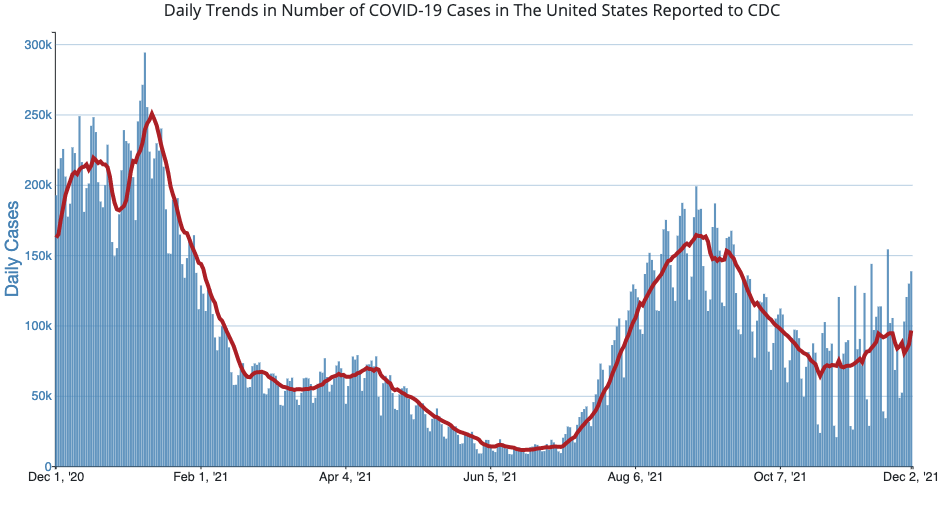
 

Daily trends in number of COVID-19 cases in the US

In addition to the rise of COVID-19 rates, we are in the cold and flu season. Be aware that your employees might be tempted to come to work sick as there the Federal Employee Paid Sick Leave has ended. Currently, 25 States have added paid sick leave for COVID pay, requiring employers to pay employees absent for COVID related reasons and receive credit through their state tax filing. Unsure if this applies to the state you’re operating in, check here.   


Let’s be mindful and conscientious, implementing the standards we were more diligently using at the start of the pandemic.  Employers have a responsibility to help keep employees healthy and prevent the spread in your workplace by mitigation risks, regardless of vaccination status.  


Suggestions:

-Implement testing protocols that conserve employee privacy

-Require masks

-Encourage social distancing

-Clean and disinfect all hard surfaces 

-Encourage regular hand-washing 

-Make hand sanitizer readily available 

Continue to allow remote/on-site employees (hybrid model) 

As an individual you can do your part to mitigate spread as well. If you haven’t already, receive your vaccine and/or booster shot. When indoors, wear your mask. Outdoor gatherings with social distancing are still a safer choice when available. Let’s do our part to stay healthy and reduce the spread this winter.

If you are unsure how to navigate these decisions and communicate with your team the how and why, HR Synergy is happy to help you. Click here to contact us.


Check-out our 2021 Year-end checklist and states with minimum wage increases.
Grateful and Thankful

Tis the season for thankfulness. Let’s show our employees and favorite non-profit organizations our gratitude. How can you show your employees appreciation and retain them in return? Research shows that companies should perform self-reflection and attend to employee retention with as much energy as typically used for recruitment and hiring. Retaining current employees through engagement and internal promotions is better and cheaper than hiring new employees. An average turnover costs about 20% of an employee’s salary for non-senior positions and costs up to 213% to fill highly specialized, senior level positions. Therefore, to continuously rehire due to high levels of unexpected turnover means great financial burden on the company.
It is no surprise why employees are leaving: the annual salary increase for the average employee being about 1%, incentive programs lacking, and companies not pivoting to support the growing number of remote employees. Explore the worth of retention initiatives.
Show employees your appreciation by listening to how they feel their job is going; don’t wait until it is too late during an exit interview. “Stay interviews” are a proactive, informal tool to gain employees’ unique perceptions of their work environment, giving you a chance to retain them. Their answers will show if they are looking for career growth or happy with what they’re doing. Use their responses to make appropriate changes to encourage them to remain with your organization. While you might not always like their responses, their feedback will ultimately save your organization money, power, and time. Feel free to modify these “stay” interview questions to best fit your specific organization and specific employees.

Massachusetts Extends COVID-19 Paid Leave through April 1, 2022

In spring 2021, Massachusetts established a statewide mandate for employers to temporarily provide employees up to 40 hours of MA EPSL when they are unable to work due to specific qualifying reasons related to the pandemic. The law was set to expire on September 30, 2021, but Massachusetts Governor, Charlie Baker signed a legislative amendment that extended the law through April 1, 2022. This new legislation does not increase the total number of additional hours employers are required to provide.

The new law also extends the coverage of the MA EPSL to allow leave to care for family members who are obtaining immunization related to COVID19 or are recovering from an injury, disability, illness or condition related to such immunization.

Beginning October 1, 2021, employees may now use COVID19 Paid Leave for the following reasons:

  • Selfisolating and caring for oneself because of the employee’s COVID19 diagnosis;
  • Seeking or obtaining a medical diagnosis, care or treatment for COVID19 symptoms;
  • Obtaining immunization related to COVID19 or recovering from an injury, disability, illness or condition related to such immunization;
  • Caring for a family member who is selfisolating due to a COVID19 diagnosis;
  • Caring for a family member who needs medical diagnosis, care, or treatment for COVID19 symptoms;
  • Caring for a family member who is obtaining an immunization related to COVID19 or is recovering from an injury, disability, illness, or condition related to such immunization;
  • Complying with a quarantine order from a public official, health authority, the employer, or a
    healthcare provider; or
  • An inability to telework due to COVID19 because they have been diagnosed with COVID19 and the symptoms inhibit their ability to telework.


As a reminder, Massachusetts employers are required to provide up to 40 additional hours of paid leave
to employees who are unable to work due to COVID19. The amount of paid leave an employee is
entitled to depends on the number of hours they work in a given week:


  • Those regularly working 40 or more hours per week will receive 40 hours of COVID19 Paid
    Leave;
  • Employees regularly working fewer than 40 hours per week will receive COVID19 Paid Leave
    that is equal to the number of hours that the employee works on average over a 14day period;
    and
  • Employees working varying hours from week to week will receive COVID19 Paid Leave equivalent to the average number of hours they worked each week over the sixmonth period immediately preceding the date on which they take the COVID19 Paid Leave. If the employee did not work a sixmonth period prior to taking leave, then they will receive leave based on their reasonable expectation of the average number of hours per week that they would normally be scheduled to work.


We will continue to monitor this new legislation and will provide updates if and/or when they occur.
Please reach out to your HR Synergy consultant of you have any questions.

More Than a Round of Applause for your Employees

It’s time to think about how to re-engage and reignite your employees as they come back to the office for work, because, according to the Prudential Pulse of the American Worker Survey, 43% report their choice to stay at their current jobs depends on how employers maneuver reentry. Incentive programs that reward and recognize employees for their contributions are a great start. As you develop appropriate incentives, remember that some workers are hesitant to return to the office due to enjoying remote work and/or public health safety concerns. You should consider, at least short-term, offering flex-hours or a hybrid work structure to accommodate changes in family commitments and public health fears. In a Paychex survey, employees reported team morale dropped from ⅔ to less than ½ due to the COVID-19 pandemic. It is time for HR to modify incentive programs to balance employees’ new wants, improve morale, and reduce unemployment and job jumping. Employee incentive programs should support transformational experiences and help professionals to become their best selves. 


What do your employees want for incentives? Ask them directly, then modify the perks accordingly. Remember, it is not a “one-size-fits-all” answer, by being flexible and innovative, you will retain happy and productive employees. While cost may seem prohibitive, research shows successful incentive programs result in an increase in weekly profits. “The Harvard Business Review reports that 40% of employees would put more energy into their work if they were recognized more.” Specifically, effective safety incentive programs should pay for themselves, realizing savings on compensation insurance anywhere from $2 to $10 on every dollar spent. As you’re developing an incentive program, don’t forget about traditional incentives: generate open communication between managers and employees, send hand written recognition notes, pay for lunches, create social media recognition posts, maintain a positive company culture, and lead relationship building experiences (see “Summer Outings” blog for ideas). Make the workplace fun again, while increasing productivity.


Taking the “Risk” out of Risk Management


Risk management means identifying, assessing  and controlling threats to an organization by  distinguishing the hazards that others miss and taking action to reduce the risk. Risks are unexpected, harmful events that cost an organization money, events such as accidents, cyber-attacks, data-related risks, financial uncertainty, IT security threats, legal liabilities, natural disasters, and strategic management errors. Crisis management must be deliberately controlled, especially during this time of the digital revolution. A way to manage risk is by designing and implementing a risk management plan.

We recommend all employers/businesses have a risk management plan outlining the procedure to identify, avoid, and control potential threats in order to minimize their impact, while reducing extra costs later. A quality risk management plan supports the organization’s goals by generating a secure work environment, lessening unnecessary insurance premium costs, protecting your most valuable assets (employees) and company assets from damage, reducing legal liability, strengthening stability of operations, and tapering issues that impact “human capital risks,” such as employee success.

An effective HR partner, risk management team, and executive leaders work together to manage risks by managing culture. They locate potential risk in three areas: hiring and retention, employee turnover, and professional fraud. Who you hire can be a source of risk with possible negative consequences. Some tips to include in your hiring/onboarding process:

  • Conducting reference and background checks as part of the hiring process is important and can help an employer identify a risk before hiring an employee.  
  • Once hired, provide all employees with an employee handbook outlining clear expectations, company policies and procedures. 
  • Employee turnover can result in loss in time and money, approximately ⅓ of the employee’s annual salary.   It’s important to hire slowly to ensure you have the right fit for the team and the organization.  
  • It’s important to manage conflicts and maintain company culture to increase retention. The timing of when an employee leaves your organization could tell you where improvement is needed. If employees leave within 10 days of employment, assess your interviewing and onboarding processes. If employees are leaving after a month, reevaluate new hire training. Leaving after a couple months may mean you should examine the employee’s manager. 
  • Compensation and benefits may be the reason you are losing employees after a year. 
  • Understanding the “Fraud Triangle” to head-off occupational fraud. The Fraud Triangle is a model commonly used in auditing that aims to explain why an employee decides to commit fraud in the workplace.  For example, when an employee has a personal financial problem, privately solves it by breaking company rules and violating financial trust, and then justifies their violations. An organization decreases professional fraud by establishing company compliance culture by implementing an anonymous reporting system without fear of retaliation, enacting random automated audit systems, and instituting clear policies with firm consequences. 

In order to determine an organization’s risks, HR audits should be conducted. “Risk assessment is at the core of every audit.” To build a quality audit, take client’s risks into consideration prior to conducting audits. Don’t just “go through the motions” of an audit. Link procedures to a risk assessment to reduce over-auditing and increase efficiency of the audit. Modify standardized, third-party procedures to address your client’s specific risks. Keep in mind as you develop your audits that significant risk is not limited to fraud. Lastly, tailor audits to each client’s needs. Following these steps will help you create a strong audit and reduce risk in your organization.

Embrace Workplace Diversity and Thrive


There are similarities and differences in all facets of your employees’ lives. Diversity in the workplace is more than racial differences. Common aspects of diversity include, but are not limited to: accent, age, disability, ethnicity, family status, sex, gender identity/expression, introvert vs extrovert, language, neurodiversity, physical characteristics, political preference, race/color, religion/belief/spirituality, sexual orientation, veteran status, and weight.

Our recent work-from-home (WFH) global shift creates space for more diversity in the workforce, as people who were unable to work in a traditional setting are now being included, which strengthens your organization. WFH naturally removes location bias and increases an organization’s geographical diversity, which can broaden diversity in age, culture, ethnicity, gender, mobility challenges, race, and sexual orientation. Instead of focusing on hiring those who “fit” your company’s culture, shift to a “culture add” mindset; look for potential employees who expand your company’s outlook.

Prejudices hamper growth, while diversity fights unconscious bias. Ultimately, embracing diversity in the workplace allows organizations to develop creative solutions that relate to our diverse world. McKinsey’s research shows that ethnically diverse and gender-diverse companies perform 35% and 15% better than peer companies, respectively. Fostering an inclusive, diverse organization improves company culture, employee retention, and engagement. Increased employee engagement can lead to collaboration, communication, and ultimately company success. As employees with a variety of skills work together, they generate innovative ideas that are productive, progressive, and profitable. A diverse workforce’s insights into a range of clients and their needs helps your organization thrive. Ultimately, this appreciation of your customer base improves employer brand and global reputation.

Does your business/organization have a DEI (diversity, equity and inclusion) plan? A quality DEI encompasses diversity in work styles, characteristics, and experiences that set employees apart. Your organization needs to learn how to leverage these attributes in conjunction with your business objectives. A team composed of individuals with diverse attributes, insights, and work practices will be more prosperous.  However, DEI is not a one-off training; it is continuous education that evolves with your employees and organization. It takes years to build a strong DEI program and there are specialists who can help you. HR Synergy encourages you to reach out to these specialists to create and implement your company’s DEI plan. 

If you are unsure how to navigate more diverse hiring practices, HR Synergy is happy to help you. Click here to contact us.