
Home » blog » Page 10

Category: blog

Workplace Poster & Massachusetts PFML

The Massachusetts Paid Family and Medical Leave (PFML) law requires employers to provide notice to all employees about the state’s PFML program. This includes information about contributions, benefits, and protections. When there are changes to contribution rates, a new notice is required to be provided to current employees 30 days in advance of any rate change. For new hires, the notice must be provided within 30 days of their start date. Employers are also required to display a workplace poster that explains the benefits available to their workforce.
The PFML contribution rate is decreasing for most employers. The rate change is effective as of January 1, 2023. This means employers must provide a new PFML notice to current employees on or before December 2, 2022.
Recently, the Massachusetts Department of Family and Medical Leave released its updated model notices. (The 2023 notice for workforces with 25 or more covered individuals is here and the 2023 notice for workforces with fewer than 25 covered individuals is here). Employers must roll this new notice out on or before December 2. Employers should also ensure that their payroll providers are planning to implement this change.
Wondering how this impacts your organization? Let’s set up a free consultation to discuss how we can help!
Useful Websites:

Mental health importance in your workforce

Everyone knows that we need to support a variety of mental health services in the workplace to encourage good mental health. However, do you know what mental health literacy is? Do you know why is it so important?

Mental health literacy is a company culture that prioritizes mental health and is composed of 5 core components.

  1. Understanding the importance of mental health.
  2. Recognizing early behaviors and triggers.
  3. Decreasing stigma.
  4. Knowing how, when and where to get help. 
  5. Ensuring managers and employees know how to support each other when facing challenges.

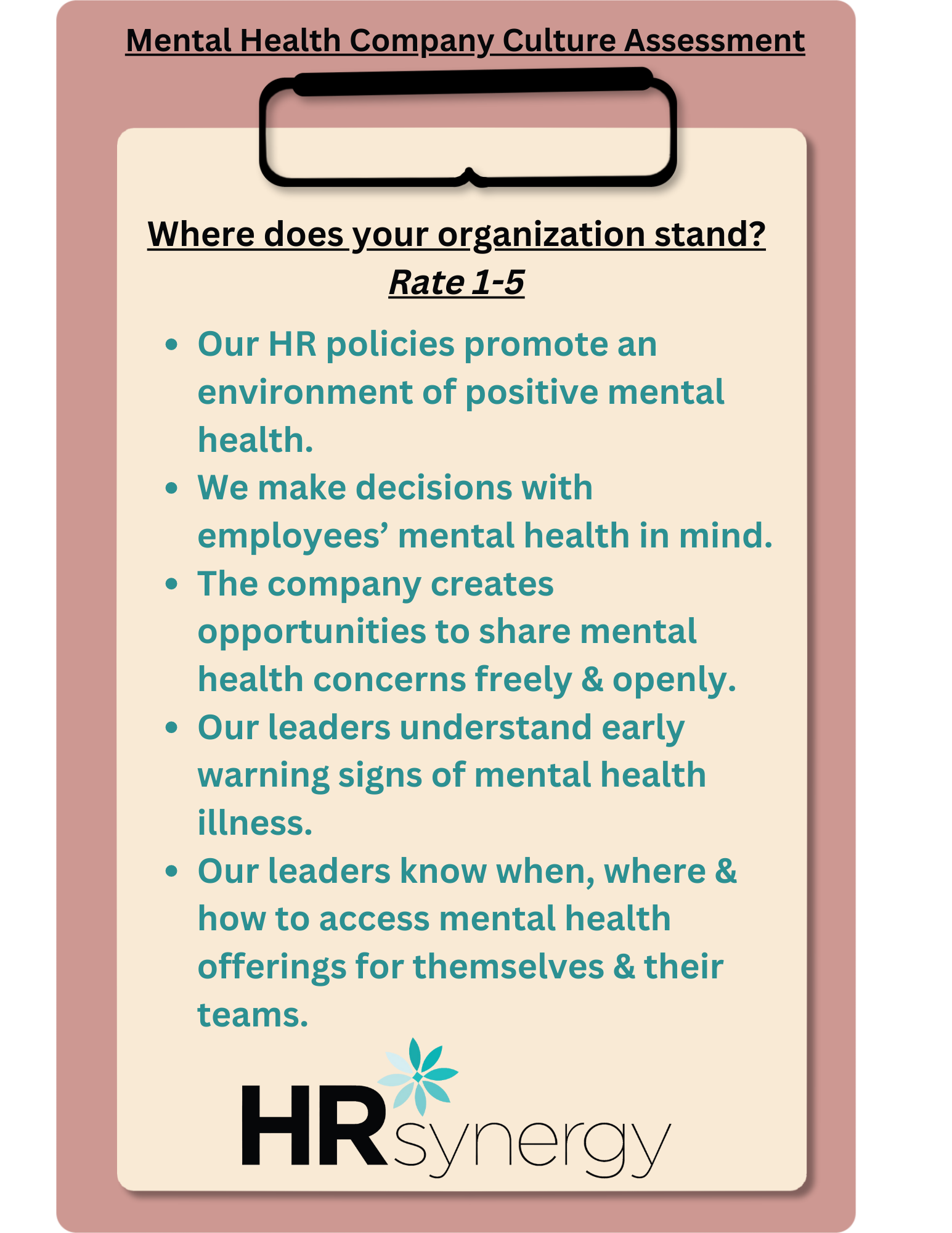
To assess your company’s workplace mental health culture, rate 1-5 where your organization stands on the statements on the Mental Health Company Culture Assessment.


As employers, we’re supporting mental health services in the workplace to encourage good mental health. However, do you know what mental health literacy is? Do you know why is it so important?
Mental health literacy is a company culture that prioritizes mental health and is composed of 5 core components.
1. Understanding the importance of mental health.
2. Recognizing early behaviors and triggers.
3. Decreasing stigma.
4. Knowing how, when and where to get help.
5. Ensuring managers and employees know how to support each other when facing challenges.
To assess your company’s workplace mental health culture, rate 1-5 where your organization stands on the statements on the Mental Health Company Culture Assessment above.
We recognize that employees do their best work when they can bring their whole, authentic selves to work, instead of separating their personal/professional lives. Let’s show our employees that we value their mental health and have the resources needed to support it. The time is now to create mental health literacy in your workplace.
Click here to contact us for ideas on maintaining mental health in your workforce.

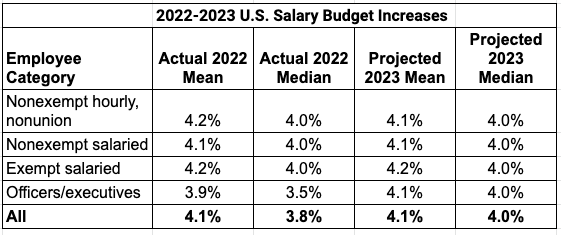
2023 Salary Budgets Projected to Stay at 20-Year High but Trail Inflation

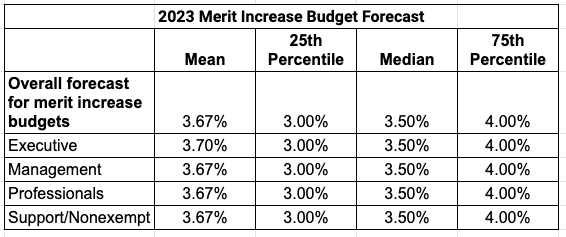
Employers continue to focus on competitive salary strategies for 2023. Over 60% of executives intend to increase compensation in response to inflation. Salary increase budgets are the pool of money available annually for base pay adjustments. While salary increase budgets are projected to grow about 4% for 2023, that is less than half of the current annual inflation rate of 8.5%.

The Consumer Price Index (CPI) increased 9.1% for the 12 month period ending in June near a 40-year high, while there was a smaller 8.5% increase for the period ending in July. If the inflation rate does not lessen in 2023, employers might feel forced to increase their salary budgets projections. However, employers might not have adequate revenues to do this if the economy continues to slow. Merit increases do not include base pay based on promotions or cost-of-living adjustments. 35% of U.S. companies are budgeting 3% and 40% are forecasting 4% or higher merit increases for 2023.

2023 pay budgets are increasing due to economic & hiring/retention pressures, inflation, and the labor market. Many employers are watching and waiting to adjust salary increases as necessary.

If you need guidance how to budget salary increases in your organization, contact us.

New Hampshire Paid Family and Medical Leave (NH PFML)

New Hampshire Paid Family and Medical Leave (NH PFML) is coming, January 1, 2023. 

The NH PFML insurance plan includes:

  • Paid Family and Paid Medical Leave together in a single insurance policy
  • 60% wage replacement benefits up to the Social Security wage cap for qualifying leave reasons
  • Leave can be taken all at once (continuous) or in partial days (intermittent) with a minimum of
    4-hour increments
  • Employers will have the choice of duration to offer under their NH PFML insurance plan:
    • Option 1: 6 paid weeks of leave 
    • Option 2: 12 paid weeks of leave

NH PFML insurance provides wage replacement during absences from work for common life events, such as:

  • One’s own serious health condition(s) when disability coverage doesn’t apply, including childbirth
  • Child bonding due to birth, adoption or fostering
  • Serious health condition(s) of a family member
  • Qualifying need arising from military deployment or service
  • Caring for a qualifying military service member

Did you know?

  • NH PFML is available to all NH employers and NH workers through MetLife, the state’s PFML insurance partner.
  • NH PFML is a first in the nation, state-sponsored, voluntary plan where NH employers and eligible NH workers can purchase a paid family and medical leave insurance plan that provides up to 60% wage replacement for covered workers for up to 6 weeks per year for absences from work for covered common life events. 
  • NH PFML insurance can be purchased from MetLife, the state’s insurance partner for the plan, either directly or through an insurance agent, broker or consultant 
  • Employers who purchase NH PFML from MetLife are eligible to receive a Business Enterprise Tax (BET) credit of up to 50% of the premium they pay on behalf of their workers.
  • Individuals who work for a NH employer may purchase NH PFML for themselves if their employer does not provide NH PFML insurance or an equivalent benefit.

You might be asking why this program is needed. It provides crucial wage replacement during a care/health need. Also, the NH PFML should increase retention through improved company morale and productivity. Lastly, a Business Enterprise Tax (BET) credit (up to 50% of the premium they pay on behalf of their workers) is available to employers who purchase NH PFML from MetLife.

Wondering how this impacts your organization? Let’s set up a free consultation to discuss how we can help!
October 2022 Deadlines

October 3 QSEHRA Notice Deadline (for QSEHRAs that begin January 1, 2023)


RDS Application Due to CMS

(for plan years beginning in 1/1/2023)

October 10 Columbus Day/Indigenous Peoples’ Day
October 14 Medicare Part D Notice of Creditable Coverage Delivered to Plan Participants

October 15 Retirement Plans Due (if filed extension)
October 17 National Boss’s Day (observed)
October 31 Forms 720 and 941 Due


Halloween

Diversity and Inclusion in the Hybrid Workplace

Don’t let out of sight mean out of mind when it comes to working from home.

Women and people of color show a preference for remote work in order to escape workplace microaggressions. What are microaggressions? Microaggressions are actions/comments that indirectly and possibly inadvertently convey prejudice toward a member of a marginalized group. 

Research shows that “about 42% of supervisors say they sometimes forget about remote workers when assigning tasks, and nearly ¾ say they would prefer all their subordinates to be in the office.” Those working from home have a promotion rate half that of in-office workers according to a Stanford economist study, despite having higher productivity compared to their in-office peers. This leads to proximity bias and those working in person might also receive more promotions. White men hold 62% of C-suite positions, white women 20%, men of color 13%, and women of color 4%, according to McKinsey % Co. with LeanIn.org in a 2021 survey. If more women and people of color are working from home and more white men are working in the office, then men are being disproportionately promoted, which impacts leadership diversity.

How can your organization curb proximity bias?

  • Train managers to better integrate remote workers.
  • Upgrade company technology.
  • Require senior leadership to work remotely occasionally. 

Also, contemplate creating a “head of hybrid work effectiveness” position. This person will oversee remote worker integration, such as if someone attends a meeting virtually, everyone does for inclusivity. The “head of hybrid work effectiveness” will intentionally be sure all contribute to work-product. Finally, this position will check-in regularly with all employees. Consider a standardized set of office/work-from-home days for all employees, including senior leadership.

Organizations should also think of remote work as an opportunity to accomplish DEI initiatives. Potential employees are no longer limited by geography, extending your reach to generate a more diverse team and expanding the diversity of mentors through virtual meetings. Additionally, employees can be evaluated on work-product without social exchanges clouding judgment. 

Click here to contact us for more ideas on maintaining diversity in your hybrid or fully remote workforce.

Health Equity in Employee Benefits

Health equity came out of the COVID-19 pandemic unveiling the healthcare imbalance. Hidden barriers encountered by employees who are people of color, members of the LGBTQ+ community, and disabled individuals came to light. 

Health initiatives have been redefined to promote equity. Has your company reimagined your health initiatives to be more inclusive? Are you actively measuring the success of these new inclusive initiatives?

Need help developing inclusive health initiatives and measuring their success? Let’s set up a free consultation to discuss how we can help!
Federal Judge Blocks Guidance on LGBTQ Workers

The U.S. District Court for the Eastern District of TN blocked guidance from the U.S. Department of Education and the U.S. Equal Employment Opportunity Commission (EEOC) on Title VII protection from discrimination of LGBTQ employees. The U.S. Supreme Court expanded the legal definition of sex discrimination to include sexual orientation and gender identity in employment situations. The guidance was blocked as it interferes with current state laws.

Transgender employees can still sue their employers for discrimination (such as failing to call them by their correct pronouns and/or blocking access to appropriate bathrooms).